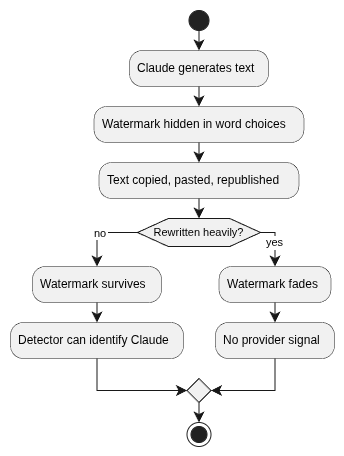
For the last few years, the whole argument about AI-written content came down to one question: can anyone actually tell? The honest answer was usually no. AI detectors looked at writing patterns and made a guess, which meant real human writing got flagged all the time and lightly edited AI text often sailed straight through.
That era is ending. The industry is moving toward something different, where the model itself marks its own output at the moment it writes it.
Anthropic has started doing exactly that with Claude. Google has been doing something similar for a while with SynthID. Once you understand how this works, a lot of assumptions about AI content pipelines stop holding up.
What Anthropic Actually Announced
Claude models released from August 2, 2026 onward embed an invisible watermark into the text they generate. The important detail is that this is not metadata sitting in a file header. It lives inside the language itself.
So a workflow like Claude to clipboard to WordPress does not strip the signal. Neither does Claude to a Node script to a database to WordPress, as long as the wording stays basically the same. Anthropic says the mark travels with the text when you copy and paste it, and that it can survive some editing.
Two more things worth knowing. First, the marking is global. This came out of European regulation, but Anthropic is applying it everywhere, so there is no clean split between EU users getting watermarks and everyone else getting a free pass. Second, the company says it is working on adding support to older Claude models too. Picking an older model is not a long term escape hatch.
The Watermark Is Hiding in the Word Choices
This is the part most people get wrong. A text watermark is not hidden HTML, weird fonts, invisible characters, or document metadata. It lives in the statistical pattern of the words the model picks while it writes.
Think about a sentence where the model could reasonably say "the results suggest a meaningful improvement," or "indicate," or "show." All three are fine. A watermarking system can quietly tilt the odds toward one of those acceptable options based on a hidden rule. Any single choice looks completely normal. But across a few hundred of those choices, a pattern emerges that a detector can measure.
That is why shuffling the text between formats does nothing. Claude to TXT to JSON to a database to HTML is still the same sequence of words, and the watermark rides along with the words.
Google's published work on SynthID gives a decent mental model here. Their approach nudges the sampling process using a hidden signal, and one of their techniques has candidate words compete under a scoring system that blends the model's normal probabilities with the watermark rule. A detector later checks whether the expected correlations show up.
The difference from old school detection is big. A traditional detector reads text and guesses. A watermark detector checks for a signature that was deliberately planted.
Worth saying clearly: Anthropic has not published its exact method. We do not know if Claude uses tournament sampling, green token lists, z-score detection, or something else entirely. The company says technical documentation on detection is coming. Until then, SynthID is a useful analogy and nothing more.
Does It Make Claude Write Worse?
Anthropic says no, and that the mark does not change the meaning, quality, or readability of the output.
Technically the watermark has to influence generation somehow, because that is the whole mechanism. Normally the model picks the best next word. With a watermark, the system slightly favors certain equally reasonable options and the model picks from those. The design goal is a bias strong enough for a detector to catch but small enough that a reader never notices.
Google's testing on Gemini across a huge number of responses reported no meaningful drop in capability or in how people rated the text. There is still a theoretical tradeoff, and if you cranked the watermark strength way up you would probably see it show up in creative writing, unusual phrasing, or high temperature output. Current systems are tuned to avoid that.
So the concern is not that Claude gets worse. It is that Claude becomes traceable. Those are very different problems.
What This Means for SEO
Could Google detect Claude-generated pages? Technically yes, if Anthropic makes detection available to third parties. Google could then check crawled pages for the signal.
But detection does not automatically mean penalty, and treating it that way would be a blunt and pretty dumb policy. Claude might have only proofread the article, translated it, tightened a section, or summarized some research the author did themselves. A watermark tells you AI touched the text. It does not tell you AI wrote the thinking.
The more realistic outcome is that provenance becomes one signal among many. Combine an AI mark with a site publishing four hundred posts a month, heavy duplication, thin information gain, and templated keyword pages, and you have a fairly obvious content farm. That is a different judgment from punishing someone for using a writing tool.
The risk is not AI equals bad. It is closer to industrial scale commodity content equals bad.
Why Open Models Break the Model
Google's own lineup shows why deployment architecture matters more than anything here.
Gemini is hosted. Google runs inference, so Google can apply SynthID automatically. Gemma is open weight. You download it and run it yourself through Ollama, llama.cpp, vLLM, or plain Transformers, and at that point you control the sampler. Google has made the watermarking tech available for developers who want to use it, but nothing forces a self-hosted Gemma instance to mark anything.
Closed models are easy to control because the provider owns every step of the pipeline. Open weight models hand that control to whoever is running the server, and the operator can change the sampling, the decoding, the logits processing, the quantization, and the fine-tuning. Mandatory provider watermarking basically stops being enforceable. The same logic applies across Gemma, Qwen, DeepSeek, Kimi, and Llama.
That does not make open model output invisible. Platforms can still look at writing patterns, duplication, publishing velocity, and site-wide automation. It just means there is no clean provider signature to check.
Open Does Not Mean Cheap
There is a funny economic wrinkle here. The weights might be free, but running them can be brutally expensive.
At the small end it is a non issue. A few billion parameters runs fine on a laptop or a cheap rented GPU. Frontier scale open models are a completely different animal, and serving one properly can mean eight high end GPUs, terabytes of memory, fast interconnect, NVMe storage, and serious cooling. A single capable server runs into six figures, and a production setup with redundancy can approach a million dollars before you have paid a single electricity bill. Then you keep paying for power, cooling, colocation, bandwidth, spare parts, and the engineers who keep it alive.
Which leads to a conclusion that sounds backwards at first. For an individual, a closed frontier API is usually the cheapest way to reach frontier intelligence. You pay twenty or fifty or a hundred dollars a month and you only pay for the slice you use, while billions of dollars of infrastructure sits behind it. Self hosting means paying for the whole machine even when it is idle.
Small open models are the cheapest path to privacy, control, and customization. Frontier open models mostly make sense for enterprises, cloud providers, governments, and very high volume operators.
Does Rewriting Remove the Watermark?
Partly, probably, and nobody can tell you exactly.
Piping Claude's output through a script that reproduces it word for word changes nothing, and swapping out a handful of words is unlikely to help either, since Anthropic says the mark can persist through some editing. But if a different model independently generates substantially different sentences, you have a new token sequence, and the original statistical signal gets weaker. Anthropic acknowledges that heavy paraphrasing, translation, editing, and content mixing can make the watermark undetectable.
What does not exist is a threshold. There is no published "replace 30 percent of the words" rule, and anyone selling you one is guessing.
The Part That Actually Matters
Dodging a watermark does not make content good, and Google does not need a Claude signature to spot a bad operation. A hundred thousand generic articles with no firsthand experience, no original research, and recycled information will get flagged on their own merits, watermark or not. Meanwhile original research, real expertise, and proprietary data can produce genuinely valuable content that Claude helped write.
The bigger shift is in the question we are asking. We are moving away from "was this written by AI" toward "which systems were involved in making this." A future content trail might read as human research, then Claude reasoning, then a Claude draft, then a local rewrite, then automated checks, then human approval, then publication. That is a much more honest description of how the work actually happens than forcing everything into a human or AI box.
And as generating sentences gets cheaper, the valuable parts of content become the things a model cannot supply: original ideas, proprietary data, real experience, judgment, accountability, and taste. The words themselves are becoming a commodity.
The practical version of all this is simple enough. Rent frontier intelligence when you need intelligence, use cheap local inference for the repetitive transformations, and verify that meaning survived the trip. Closed models give you frontier capability without owning a datacenter. Open models give you control, privacy, and nearly free inference on narrow tasks. The best systems will not pick a side. They will use both, and watermarking might be the thing that finally forces people to think clearly about which model belongs where.