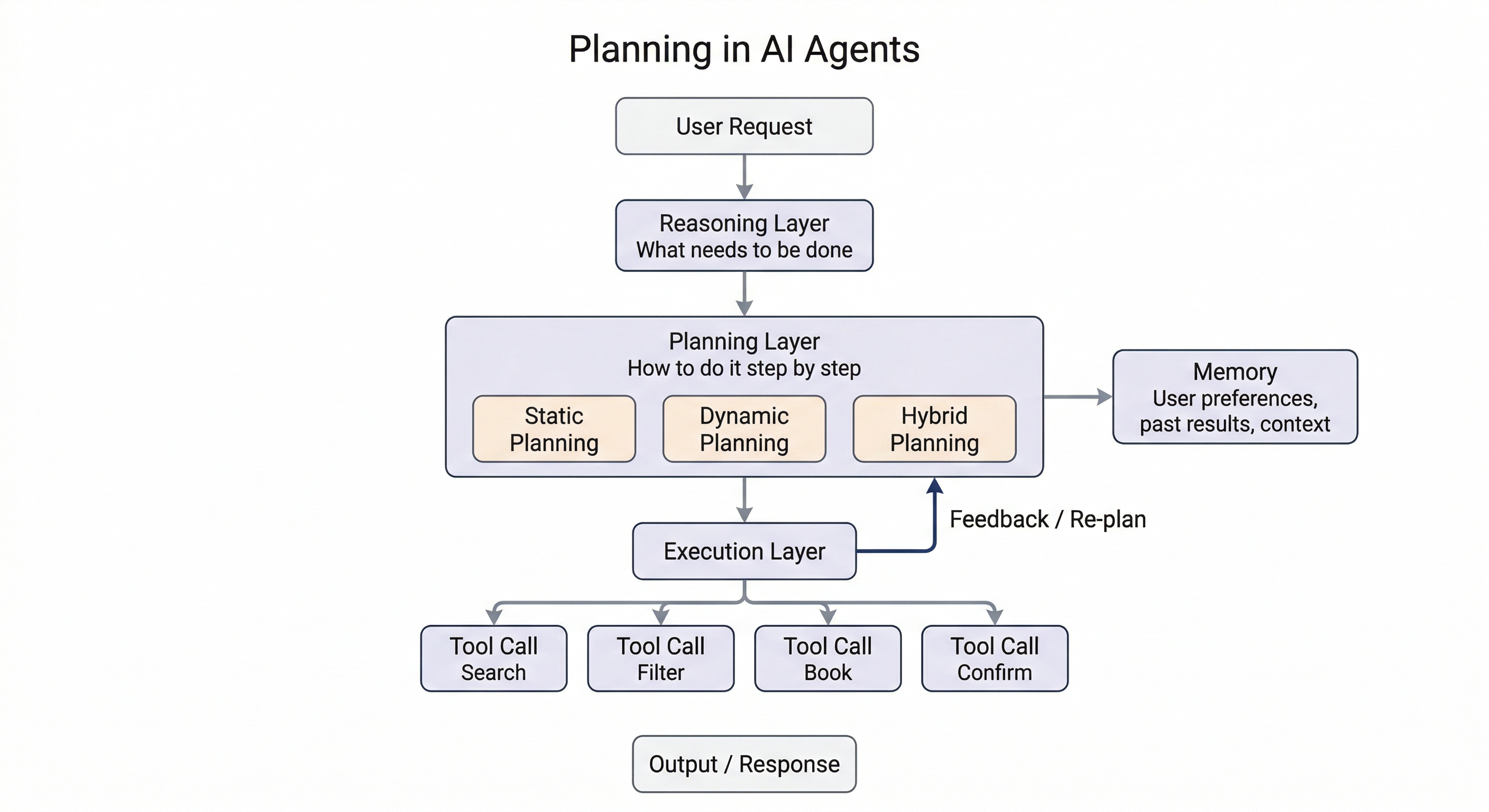
Planning is where agents start behaving less like chat systems and more like systems that can act. So far, we have looked at the core pieces: tokens, tools, and memory. These define what an agent can understand, access, and remember. But none of that matters if the agent cannot decide what to do next. That is where planning comes in. At a high level, planning is about taking a complex request and turning it into a sequence of smaller, executable steps.
For example, consider a user asking: "Find me a good lawyer nearby, check their availability this week, and book a consultation." This is not a single action. It is a chain of actions. The agent needs to understand the intent, search for lawyers, filter based on location and quality, check availability, interact with a booking system, and confirm the result. Without planning, the agent either fails or tries to do everything in one step, which usually breaks.
What is Planning in AI Agents
Planning is the process of decomposing a task into structured steps and deciding the order in which they should be executed. It sits between reasoning, which determines what needs to be done, and execution, which actually does it via tools. Reasoning tells you what to do. Planning decides how to do it step by step. Tools execute each step.
Why Simple Prompting Breaks
If you try to handle complex tasks with a single prompt, a few things happen: the model mixes multiple objectives, tool calls become unreliable, intermediate results are lost, and error handling becomes impossible. For simple Q&A, this is fine. For multi-step tasks, it fails quickly. Planning introduces structure.
Breaking Tasks into Steps
Let's take the same example and break it down. A user requests: "Find a lawyer and book a consultation." A planned version of this might look like:
- Search for lawyers in the given location
- Rank them based on reviews or specialization
- Select the top candidate
- Check availability for the next 7 days
- Choose a suitable time slot
- Book the consultation
- Confirm back to the user
Notice something here. Each step has a clear input, produces an output, and can be mapped to a tool. This is what makes execution reliable.
Types of Planning
Not all agents plan the same way.
Static Planning
The agent generates a full plan upfront and then executes it step by step. This works well when the task is predictable, tools are reliable, and no major surprises are expected. But it struggles when the environment changes.
Dynamic Planning
Here, the agent plans as it goes. After each step, it evaluates the result, updates the plan, and decides the next action. This is closer to how humans operate. It is slower, but more robust.
Hybrid Planning
Most real systems use a mix of both. They generate an initial plan and adapt it during execution. This balances speed and flexibility.
Planning and Tools
Planning is tightly connected to the tool layer. Each step in a plan should ideally map to one tool call or a small set of tool interactions. If your tools are poorly defined, planning becomes messy. If your tools are clean and modular, planning becomes straightforward. This is why tool design and planning are not separate concerns.
Planning and Memory
Planning also depends on memory. The agent may need to remember previous user preferences, reuse past results, or maintain context across steps. For example, if the user prefers morning slots, the plan should account for that. Without memory, planning becomes stateless and less useful.
Where Things Get Hard
Planning sounds simple in theory, but a few challenges show up in practice: deciding the right level of granularity, handling failures in intermediate steps, avoiding unnecessary steps, keeping plans interpretable, and managing latency as steps increase. This is where system design matters more than just prompting.
What This Means in Real Systems
If you are building an agent today, planning is not optional. As soon as your use case involves multiple tools, multiple steps, or real-world actions, you need a planning layer. Otherwise, the system becomes fragile very quickly. Planning is what turns capabilities into coordinated behavior.
If you're enjoying this post, consider subscribing to get future articles delivered straight to your inbox.
Subscribe